Time-Resolved X-ray Absorption Spectroscopy to Probe Cobalt Dynamics in Fe₂O₃-CoPi Photoanodes During Photoelectrochemical Oxygen Evolution
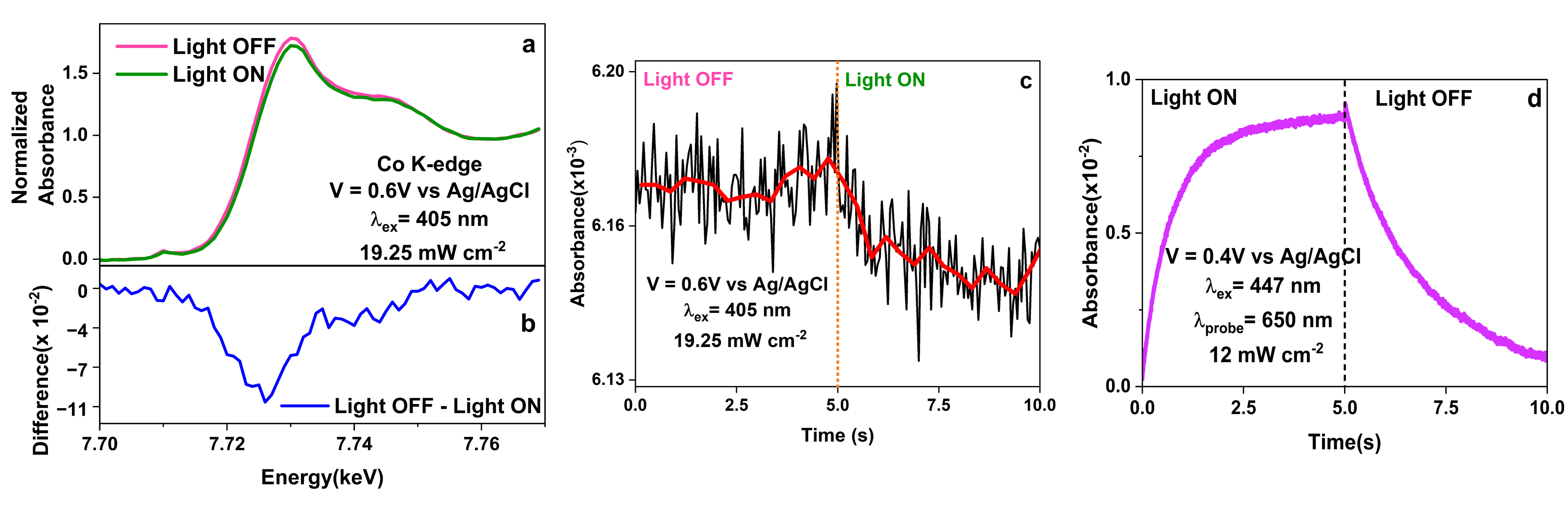
Hematite (α-Fe₂O₃) is a promising photoanode for solar water splitting due to its chemical stability and suitable bandgap. However, its performance is limited by poor charge transport and sluggish oxygen evolution reaction (OER) kinetics. Cobalt phosphate (CoPi) has been used as a co-catalyst to improve Fe₂O₃ activity, but the exact role of cobalt remains unclear. Three main functions have been proposed: (1) acting as a hole accumulator to enhance charge separation [1], (2) directly participating in OER via Co(IV) intermediates at the cobalt oxyhydroxide surface [2], and (3) enhancing light absorption through its oxides, which absorb visible light and serve as catalytic sites [3].To investigate these roles, we employ time-resolved X-ray absorption spectroscopy (XAS) at the Co K-edge (Fig. 1a–c) to probe the electronic and structural dynamics of Fe₂O₃-CoPi photoanodes under operating conditions. A large set of XAS spectra was analyzed following established methods [4]. Additionally, we recorded optical absorption changes under light modulation (Fig. 1d) and correlated these with photocurrent measurements using the approach in [5] to assess hole accumulation. Steady-state Co K-edge XAS shows a shift toward higher cobalt oxidation states near OER potentials, indicating the formation of Co(III) species. Under modulated light, time-resolved XAS difference spectra suggests reversible oxidation from Co(II) to Co(III), consistent with hole accumulation (Fig. 1b). Kinetic data (Fig. 1c) for selected edge energies (7.70–7.77 keV) highlight hole recombination dynamics at Co sites. Comparing XAS and optical data clarifies the contribution of Co centers to hole accumulation. To further probe their catalytic role, time-resolved XAS was also performed at two applied potentials corresponding to redox peaks in the cyclic voltammogram.Our findings provide a deeper understanding of the cooperative interactions between Fe₂O₃ and CoPi, potentially guiding the rational design of more efficient photoelectrodes for solar-driven water splitting.
[1]M. Barroso, et al., J. Am. Chem. Soc. 133 (2011) 14868-14871.
[2]A. Moysiadou, et al., J. Am. Chem. Soc. 142 (2020) 11901-11914
[3]E. A. Sprague-Klein, et al., ACS Energy Lett. 7 (2022) 3129-3138
[4]G. Smolentsev, et al., J. Chem. Phys. 130 (2009) 174508
[5]F.Le Formal, et al., J. Am. Chem. Soc. 137 (2015) 6629−6637