In The Heart of CH: Spectroscopic Insights into Proper C−H Hydrogen Bonds
Hydrogen bond (HB) is typically identified by two defining spectroscopic features: downfield shift of the bound proton in NMR, and a redshift in the X−H (X is a donor atom) stretching frequency compared to the free species. A red shift suggests an X−H bond elongation and is characteristic for classical O−H or N−H HB donors (proper HBs). On the other hand, in rare cases when C−H bonds engage in hydrogen bonding they contract and their frequency blue-shifts (improper HBs). But are all C−H hydrogen bonds improper?
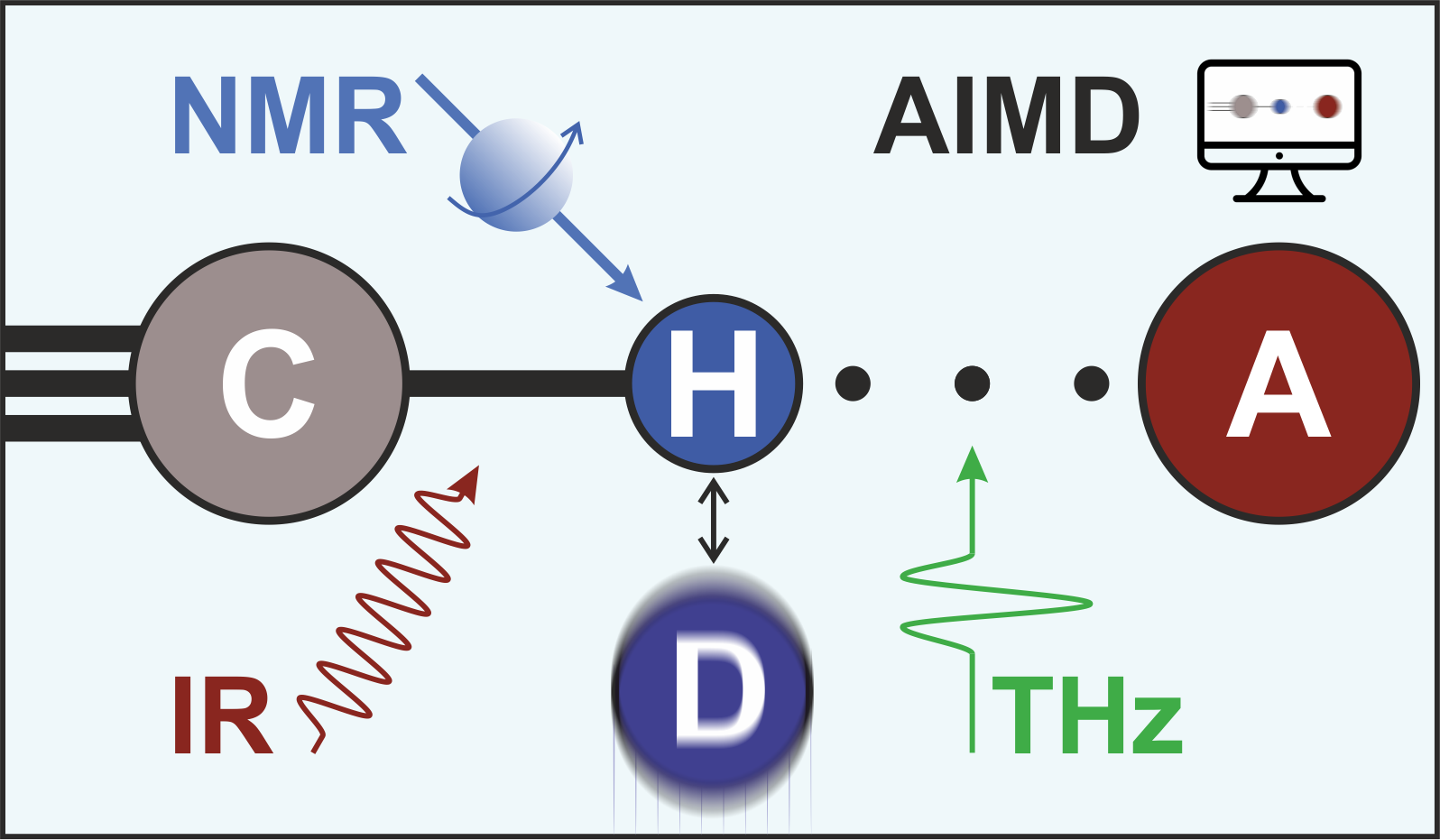
Here, we present a comprehensive study of a model system featuring a hydrogen-bonding terminal alkyne proton, investigated using a broad array of spectroscopic techniques – including NMR, IR, and THz spectroscopy – complemented by ab initio molecular dynamics simulations, across more than 50 solvation environments. We observe that this molecule not only forms C−H hydrogen bonds with all electron-donating solvents (including C−H…π HBs with aromatic compounds) but also displays a strikingly prominent red-shift (exceeding 200 cm-1) in the C−H stretching frequency upon hydrogen bonding, contrary to the typical blue-shifting improper C−H hydrogen bonds. By experimentally disentangling contributions of solvent-induced electric fields (Stark effect) from non-electrostatic (e.g., bond polarization, charge transfer components), we dissect key physical factors that determine this intermolecular interaction. Furthermore, we were able to directly interrogate its vibrational signature in the THz region – bending and stretching of H…A (A is an H-bond acceptor atom) bond – as well as establish details of its spatial arrangements. Remarkably, we also demonstrate that this system undergoes rapid spontaneous proton exchange in the absence of any acidic or basic catalysts similar to conventional O−H and N−H protic solvents.
Our findings not only provide a rare spectroscopic insight into a strongly hydrogen-bonding C−H system but also highlight the intricate interplay of forces governing intermolecular C−H interactions, as well as invite a reassessment of common assumptions about hydrogen bonding.