Near-Unity Single-Photon Chiral Transduction from a Single Gold Helicoid to a Perovskite Quantum Dot
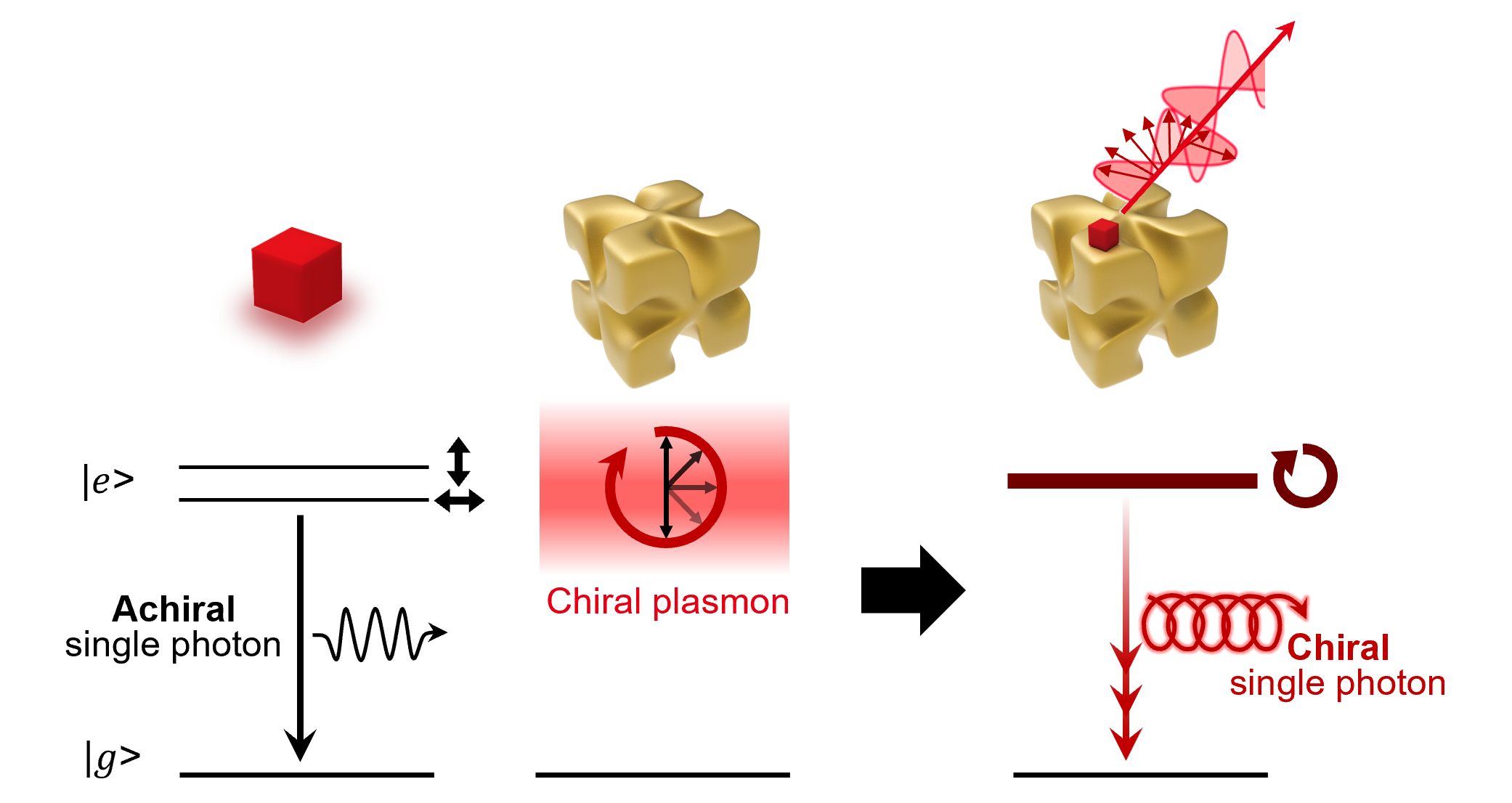
Precise manipulation of light-matter interactions is essential for the development of quantum technologies. The Purcell effect, a key mechanism for enhancing the efficiency of quantum light emission1, has been instrumental in generating photons with high indistinguishability, thereby pushing forward applications in photonic quantum computing2. A promising frontier in this field lies in the use of chiral photon modes to achieve quantum-level control over light polarization3. Using a single perovskite quantum dot (PQD) as a point emitter enables direct probing of the precisely engineered nanoscale optical helicity (h) of the gold helicoid, overcoming the averaging effects typically imposed by the optical diffraction limit. Serving as a localized signal transducer, the excitons in the PQD couple strongly with the chiral electromagnetic hot spots of the helicoid structure. This interaction leads to the emission of single photons carrying spin angular momentum (SAM), with their generation rate deterministically controlled by the helicoid’s handedness-selective excitation. By fine-tuning the near-field coupling and the excitonic and plasmonic spectral resonances, we achieved single-photon chirality as high as 80% and an excitation dissymmetry factor reaching 90%, achieving a full optical chirality (excitation-emission) with a near-unity efficiency. These results are accompanied by rapid radiative decay (~300 ps) and a Purcell enhancement factor of approximately 3. Through numerical simulations of the electromagnetic field, we also demonstrate dual-mode circular dichroism behavior, where the chirality of excitation can be modulated via the excitation wavelength. This highly efficient chiral transduction paves the way for novel quantum light sources, with potential applications spanning integrated quantum photonic circuits and nanoscale chiroptical sensors.
[1] E. M. Purcell, H. C. Torrey, R. V. Pound, Phys. Rev. 1946, 69, 37.
[2] N. Maring et al. Nat. Photonics 2024, 18, 603-609.
[3] P. Lodahl et al. Nature 2017, 541, 473-480.