Catalysis for molecular solar thermal systems: From surface science to the solid/liquid interface
In this presentation, we review recent work that aims at the development of tailored catalysts for controlled energy release in molecular solar thermal (MOST) systems. MOST systems utilize photoswitchable molecules to convert solar energy into chemical energy through simple unimolecular reactions. Thus, they provide a sustainable and efficient alternative for solar energy storage.[1] However, a persistent challenge lies in the effective triggering of the back-conversion reaction to release the stored energy on demand. In our studies, we combine surface science studies and in-situ methods at the solid/liquid interface to study catalytically, electrocatalytically and electrochemically triggered energy release strategies.[1-4]. For norbornadiene/quadricyclane based MOST systems, we demonstrate that Au interfaces are among the most active and selective catalysts known so far. Using photoelectrochemical infrared spectroscopy, we show that Au(111) surfaces can remain active over 1,000 storage cycles, retaining their structural integrity and losing less than 0.1% catalytic activity per cycle. More advanced “electro-switchable” catalysts allow us to control the rate of energy release via the applied electrode potential, enabling dynamic regulation of the energy release. We show that for Au-based catalysts, the energy release rate is indeed potential-dependent and can be adjusted over at least two orders of magnitude.[2]
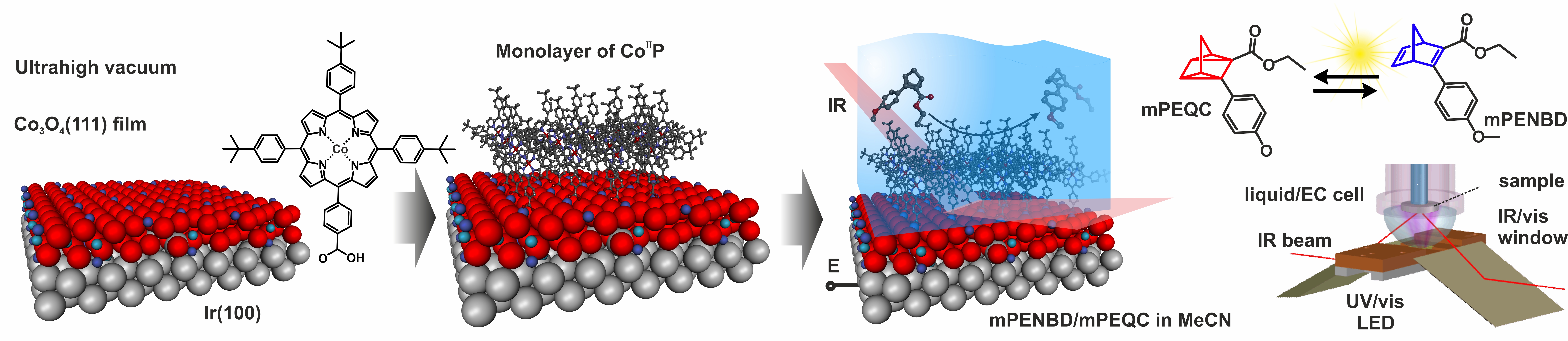
Finally, we discuss the development of electroswitchable, noble metal-free hybrid catalysts based on immobilized organometallic complexes. Such hybrid catalysts combine the advantages of heterogeneous and homogeneous catalysis and provide systems that are easy to separate, highly selective and free of noble metals. For a functionalized Co(II) porphyrin anchored to an atomically defined cobalt oxide electrode, we demonstrate high catalytic activity and stability during repeated energy storage and release cycles, while the activity can be reversibly switched off by reduction to the Co(I) state.
[1] Z. Wang, P. Erhart, T. Li, Z.-Y. Zhang, D. Sampedro, Z. Hu, H. A. Wegner, O. Brummel, J. Libuda, M. Brøndsted Nielsen, K. Moth-Poulsen, Joule 2021, 5, 3116.
[2] E. Franz, C. Stumm, F. Waidhas, M. Bertram, M. Jevric, J. Orrego-Hernández, H. Hölzel, K.
Moth-Poulsen, O. Brummel, J. Libuda, ACS Catalysis 2022, 12, 13418.
[3] R. Eschenbacher, F. Hemauer, E. Franz, A.D. Leng, V. Schwaab, N.J. Waleska-Wellnhofer, E.M. Freiberger, L. Fromm, T. Xu, A. Görling, A. Hirsch, H.P. Steinrück, C. Papp, O. Brummel, J. Libuda, ChemPhotoChem 2024, 8, e202300155
[4] E. Franz, G. Fickenscher, E. J. Schulze, D. Krappmann, A. Weidlich, T. Luchs, A. Dreuw, A. Hirsch, O. Brummel, J. Libuda, ACS Energy Letters 2025, under revision.