Towards the new types of memory devices using molecular electronics
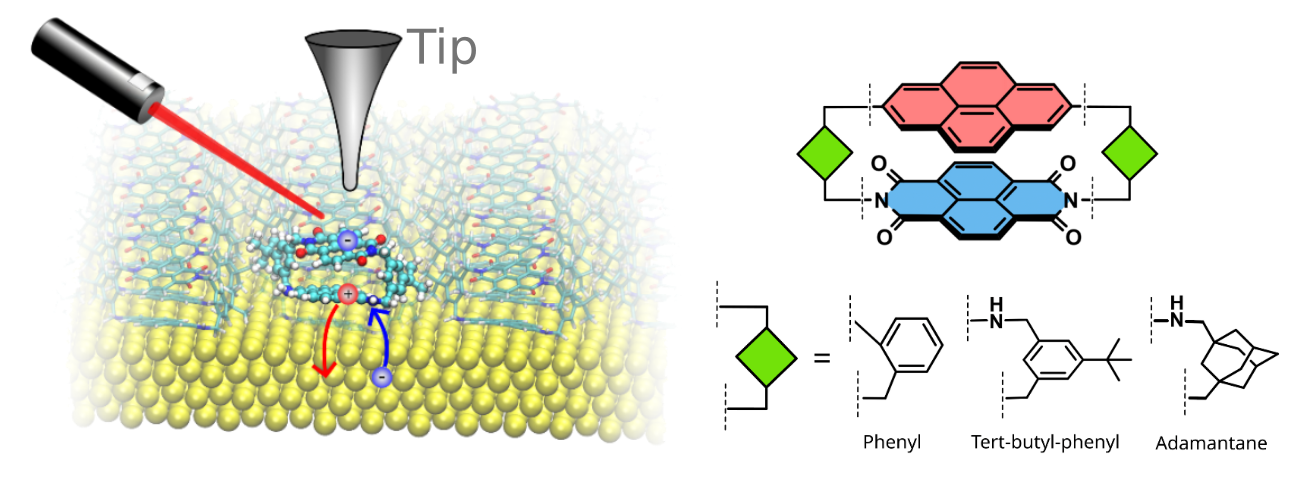
Molecular electronics is seen as a route to further miniaturize microelectronics and to extend Moor’s law beyond the limits of semiconductor-based platforms. The molecular electronics devices make use of the quantum nature of electrons and their control to facilitate specific functions. Our main focus here is on molecular electronics memories, where the specific resonance interaction between an electrode surface plasmon and the charge transfer state of an active molecule is used to influence the charge distribution by an external electric or magnetic field. In this project, we focus on investigating the nature of the coupling between active molecules and metallic electrodes. Understanding the interplay of the different interactions such as exciton-exciton, charge transfer and exciton-plasmon interactions and their dependence on the coupling between the active molecule and the surface, is a crucial step in developing novel molecular electronic devices. We aim to develop a computationally affordable approach correctly describing intrinsic quantum effects like mixing of the locally excited or charge transfer states with the surface plasmon resonance. This is essential for large-scale investigations of the new type of molecular devices. Promising system that can serve as prototypes for future molecular memories are paracyclophane molecules deposited on a gold surface. These molecules contain two aromatic units stacked parallel and fixed by linkers, offering a well-defined structure with controlled inter-unit conformation. When paracyclophane is formed by two different units e.g. naphthalenediimide-Pyrene or naphthalenediimide-Azulene, we observe large charge transfer (CT). By varying the linker’s length and flexibility, we can systematically adjust the inter-unit distance and orientation, thereby modifying CT state properties and obtaining excited state energies close to the gold plasmon resonance with the CT transition dipole moment perpendicular to the gold surface. Resonant coupling between the CT state and the gold plasmon resonance could then be utilized for future molecular memories. I’ll present computational strategy for accurate treatment of the CT states as well as the locally excited states of the paracyclophanes and investigate electronic interaction between the paracyclophane and the gold surface. Comparison of computed and experimental optical spectra and STM show excellent agreement and validating the proposed computational methodology.