Thermoresponsive polymers in biological environments: Impact of ions, small molecules and macromolecules on critical temperature
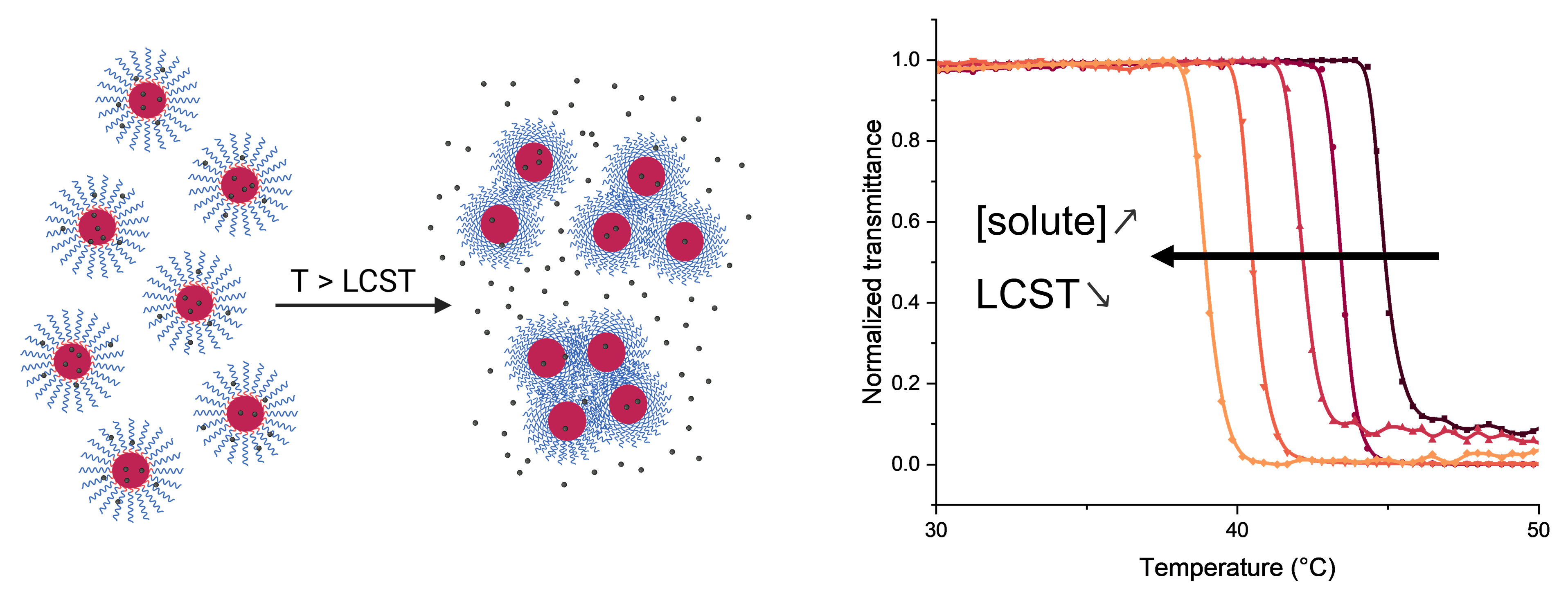
Stimuli-responsive polymeric self-assemblies are promising drug delivery platforms offering on-demand release with dose and spatiotemporal control over delivery. Thermoresponsive polymers are widely explored as building blocks for such drug delivery systems. Polymers with a lower critical solution temperature (LCST) have hydrated polymer chains below the critical temperature (cloud point), but once heated beyond the LCST, they undergo entropy-driven hydrophobic collapse and aggregation.1,2 However, their behavior is most often studied in pure water or PBS, which poorly mimics the complex biological environment. This overlooks the potential influence of biologically relevant ions, small molecules and macromolecules present at high concentrations in vivo.3
Herein, we systematically investigate how various ions, small molecules and macromolecules modulate the LCST of thermoresponsive polymers. We present the synthesis of novel thermoresponsive amphiphilic block copolymers based on poly(butyl acrylate) (PBA) and poly(di(ethylene glycol) methyl ether acrylate) (PDEGA). We synthesized a library of new PBA-b-PDEGA copolymers with varying end-groups and block lengths while maintaining precise control over polymer molecular weight and polydispersity. We tested the thermoresponsive behavior of PDEGA homopolymers and PBA-b-PDEGA copolymers in the presence of biologically relevant solutes. It was observed that ions, small molecules and macromolecules can significantly alter the critical temperature, reducing it up to 10 °C. This highlights the importance of testing thermoresponsive polymers in complex media to better predict their behavior in physiological environments.
[1] A. Bordat, T. Boissenot, J. Nicolas, N. Tsapis, Advanced Drug Delivery Reviews., 2019, 138, 167–192.
[2] A. Nikoletić, M. Maleković, G. Kozalak, C. G. Palivan, O. Tagit, Helvetica Chimica Acta, 2025, 108, e202400193.
[3] D. A. Estabrook, J. O. Chapman, S.-T. Yen, H. H. Lin, E. T. Ng, L. Zhu, H. L. van de Wouw, O. Campàs, E. M. Sletten, Journal of the American Chemical Society, 2022, 144, 37, 16792–16798