Computational design of single-atom catalysts for sustainable vinyl chloride synthesis
Acetylene hydrochlorination, a key technology for vinyl chloride monomer synthesis, urgently
needs to transition away from toxic HgCl2 catalysts in pursuit of more sustainable alternatives.
Single-atom catalysts (SACs) based on transition metals, particularly platinum, have emerged
as promising candidates, combining high durability and productivity. [1,2] Enhancing their activity
and fully exploiting their potential requires atomistic insight into how active sites form during
synthesis, evolve under reaction conditions, and ultimately govern catalytic performance. As
the smallest possible metal ensembles, SACs provide a unique opportunity for such
understanding due to their comparatively well-defined structures. However, current theoretical
approaches often fall short by neglecting synthetic history, oversimplifying support effects, and
using stability descriptors disconnected from realistic conditions. [3] To overcome these gaps,
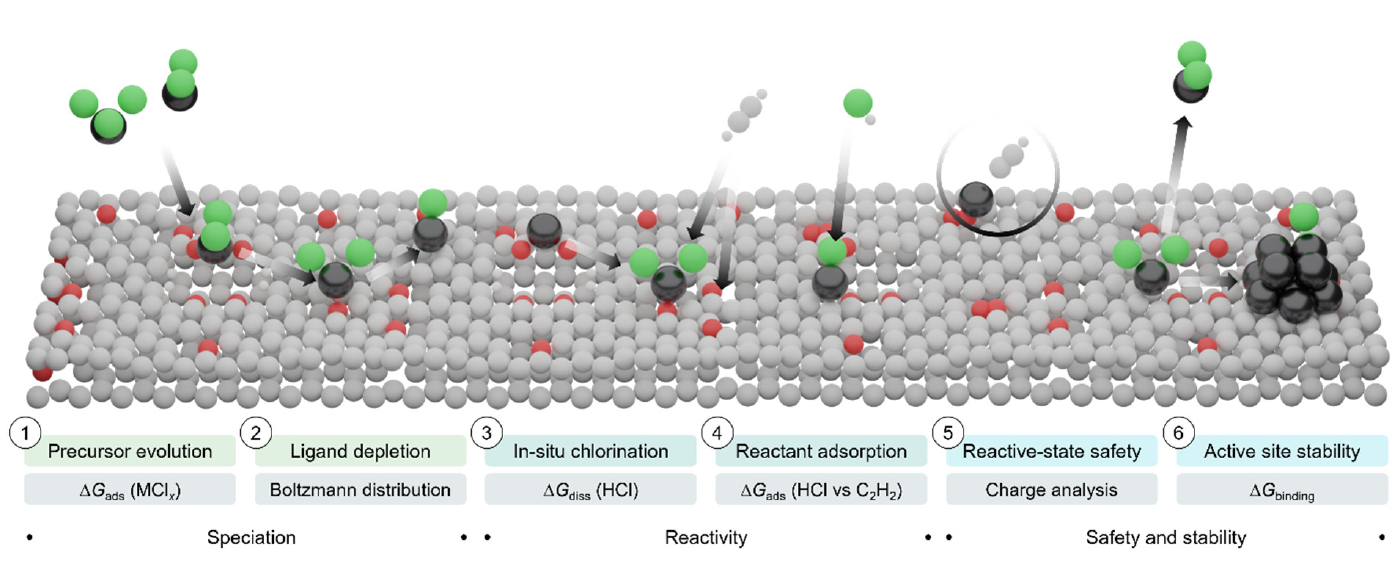
we introduce a thermodynamically grounded, coordination-resolved computational framework.
By explicitly simulating the synthesis-structure-property-performance relations of carbon-
supported SACs under relevant synthesis and reaction conditions (e.g. 473 K and p HCl ~ 0.5
atm), the model captures dynamic changes in site speciation. [2] Applied to relevant transition
metals (Pt, Au, Cu, Ru), our approach reproduces over 80% of coordination environments
observed via operando X-ray absorption spectroscopy, and reveals how structural evolution
under working conditions affects both catalytic activity and deactivation. These results
demonstrate the frameworks predictive value for guiding catalyst selection and optimization in
acetylene hydrochlorination and beyond.
[1] S.K. Kaiser, E. Fako, G. Manzocchi, F. Krumeich, R. Hauert, A.H. Clark, O. Safonova, N. López, J. Pérez-
Ramírez, Nat. Catal. 2020, 3, 376.
[2] V. Giulimondi, A. Ruiz-Ferrando, G. Giannakakis, I. Surin, M. Agrachev, G. Jeschke, F. Krumeich, N. López,
A.H. Clark, J. Pérez-Ramírez, Nat. Commun., 2023, 14, 5557.
[3] F. Kraushofer, G.S. Parkinson, Chem. Rev. 2022, 122, 14911.