Excited Radical Ions in Organic Photocatalysis: A Photophysical Perspective
The use of excited organic radical ions as photocatalysts for thermodynamically challenging synthetic reactions has been a topic of intense research in the past few years. Since the first report on the use of the excited radical anion of a perylene diimide derivative (2PDI•−*) as a photocatalyst for the reduction of aryl halides in what came to be known as consecutive photoinduced electron transfer (conPET) mechanism,[1] many questions have been raised as the mechanism is constantly under scrutiny. This process is based on the excitation of PDI in the presence of a sacrificial electron donor, reductively quenching 1PDI* to generate its radical anion form. From there, a second photon excites 2PDI•− and produces the species that is claimed to be the photocatalyst in the synthetic reaction. One of the main points of scrutiny in this mechanism is the very short lifetime of the D1 excited state of 2PDI•−* (145 ps),[2] making it highly unlikely for this species to engage in any diffusion-driven electron transfer process with a substrate. Previous studies have attributed the observed photocatalytic activity to photoproducts of the decomposition of 2PDI•−*,[2] or even considered a pre-association between the excited radical anion and the substrate,[3] but a full description of the mechanism involving this elusive species is still missing. Our photophysical approach to this problem consists in photochemically generating the radical ion species and later probing its excited state properties via ultrafast optical absorption spectroscopy by using a double pump excitation strategy. Starting from a neutral ground state PDI derivative (Figure 1, left panel), we take an unusual pathway for the generation of the elusive 2PDI•− in high concentration. We first induce the population of the excited triplet state of the dye (3PDI*) by using halogenated electron donors (D1),[4] resulting in a high yield of 3PDI* that peaks at 20 ns with characteristic absorption bands at 470, 505, and 555 nm (Figure 1, right panel).
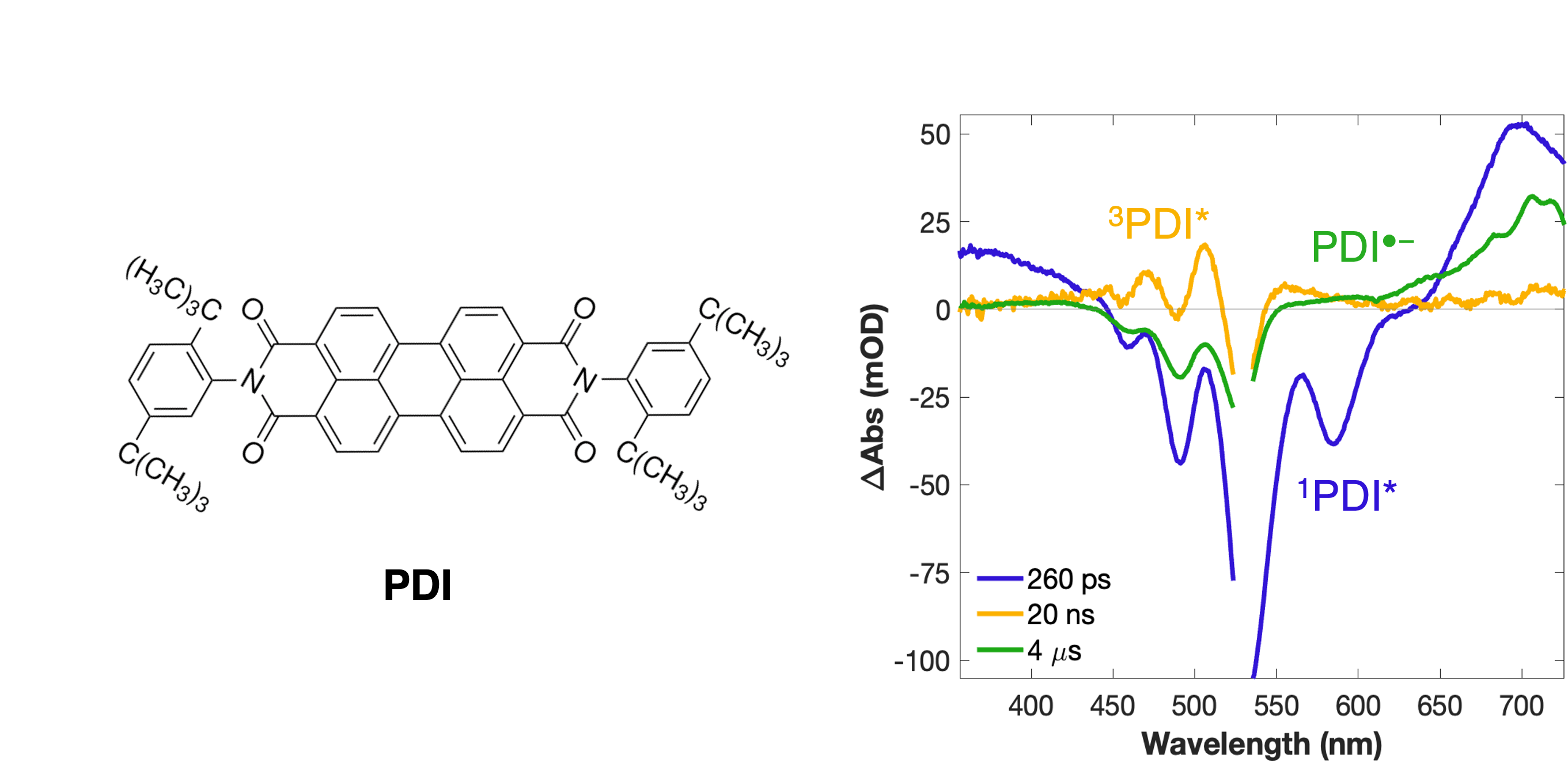
Once populated, 3PDI* can be efficiently quenched by a second electron donor (D2) to yield the free 2PDI•− species whose maximal concentration is observed 4 µs after excitation as evidenced by its intense absorption features above 600 nm (Figure 1, right panel). From there, a second actinic pump can be used to selectively populate the excited state of the photogenerated radical anion, probing its ultrafast dynamics in the presence and absence of aryl halide substrates, therefore shining some light on the photocatalytic mechanism for the full photochemical scheme.
[1] I. Ghosh, T. Ghosh, J.I. Bardagi, B. Konig., Science 2014, 346, 725-728.
[2] M. Marchini, A. Gualandi, L. Mengozzi, P. Franchi, M. Lucarini, P. G. Cozzi, V. Balzani, P. Ceroni., Phys. Chem. Chem. Physics. 2018, 20, 8071-8076
[3] B. Pfund, D. Gejsnaes-Schaad, B. Lazarevski, O. S. Wenger, Nat. Commun. 2024, 15, 4738.
[4] O. Nicolet, E. Vauthey, J. Phys. Chem. A 2003, 107, 5894.