Transient IR spectroscopy - an ultimate tool for mechanistic studies - applied to catalytic CO2 reduction by transition metal complexes
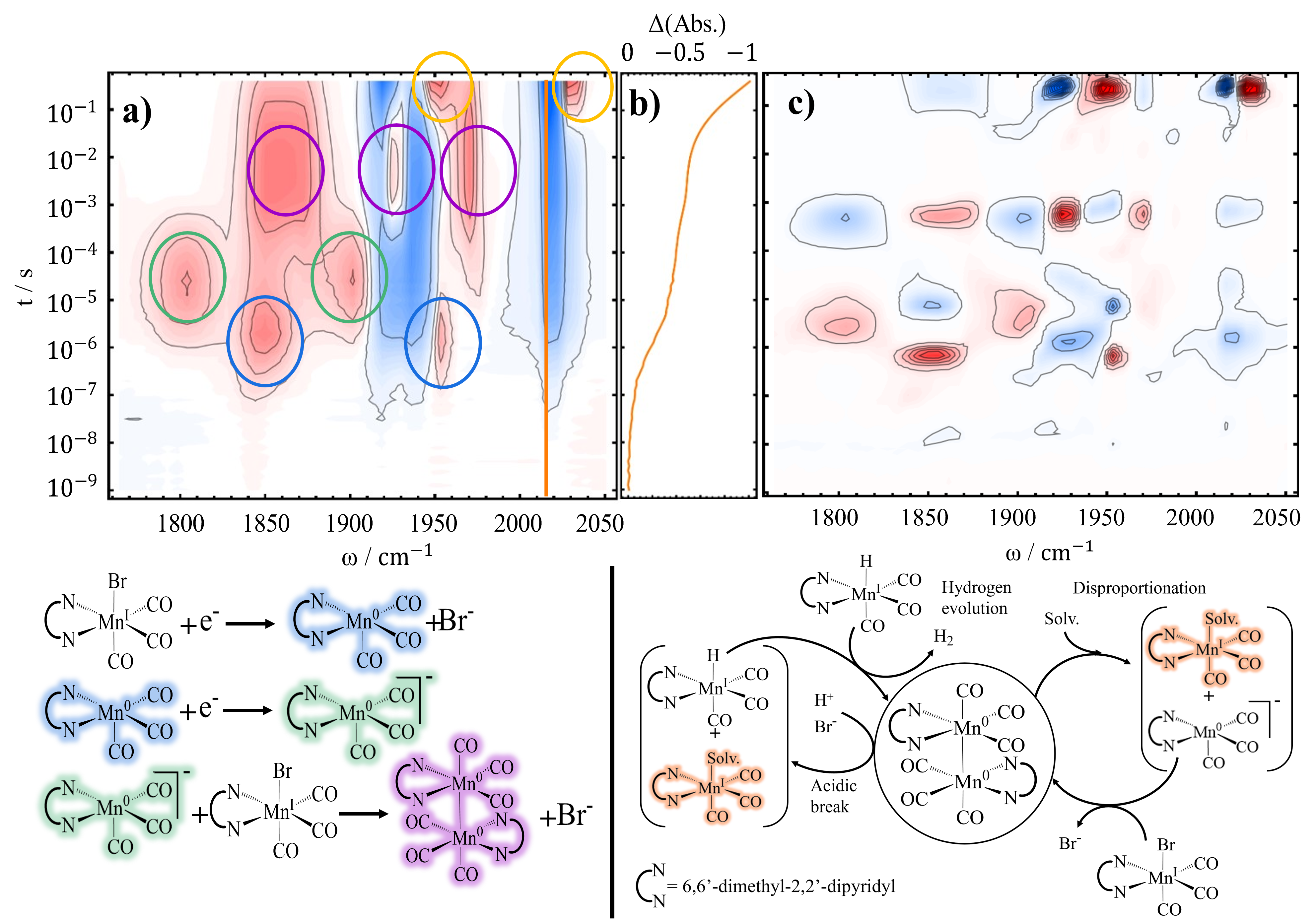
Catalytic CO2 reduction is a cornerstone of sustainable energy strategies. Since the 1980s, transition metal complexes have garnered significant attention for this application due to their multiple accessible redox states, which make them ideal platforms for multi-electron transfer processes. Extensive research has been devoted to elucidating catalytic mechanisms through electrochemical studies. However, such studies lack precise control over the number of electrons transferred and often fail to provide sufficient temporal resolution to capture key intermediates essential for a complete understanding of catalytic pathways. This information is crucial for designing more efficient catalysts suitable for large-scale, real world applications. To address these limitations, we have employed time-resolved infrared (TRIR) spectroscopy to investigate pathways towards catalytically active states of Mn-based transition metal complexes, which are used as pre-catalysts [1-3]. These complexes contain metal carbonyl ligands, allowing us to monitor electron density changes on the metal center through frequency shifts in the CO stretch region, which is characterized by a strong IR absorption cross-section.
[1] Takeda, H., Koizumi, H., Okamoto, K., & Ishitani, O., Photocatalytic CO2 reduction using a Mn complex as a catalyst. Chemical communications, 2014, 50(12), 1491-1493.
[2] Grills, D. C., Farrington, J. A., Layne, B. H., Lymar, S. V., Mello, B. A., Preses, J. M., & Wishart, J. F., Mechanism of the formation of a Mn-based CO2 reduction catalyst revealed by pulse radiolysis with time-resolved infrared detection. Journal of the American Chemical Society, 2014, 136(15), 5563-5566.
[3] Sampson, M. D., Nguyen, A. D., Grice, K. A., Moore, C. E., Rheingold, A. L., & Kubiak, C. P., Manganese catalysts with bulky bipyridine ligands for the electrocatalytic reduction of carbon dioxide: eliminating dimerization and altering catalysis. Journal of the American Chemical Society, 2014, 136(14), 5460-5471.