Feature Selection in Multivariate Linear Regression Models for Data-Efficient Reaction Optimization
Reliable machine learning models are difficult to develop in the early stages of reaction optimization due to data scarcity. To address this limitation, chemists have turned to multivariate linear regression (MLR) models that rely on a small set of carefully selected molecular features, such as charges, angles, and volumes. Despite MLR’s simplicity and high interpretability, its practical application depends on selecting only a few relevant features from a typically large pool. However, existing feature selection approaches for reaction optimization are often inconsistent, leading to suboptimal models and providing limited insight into model quality.
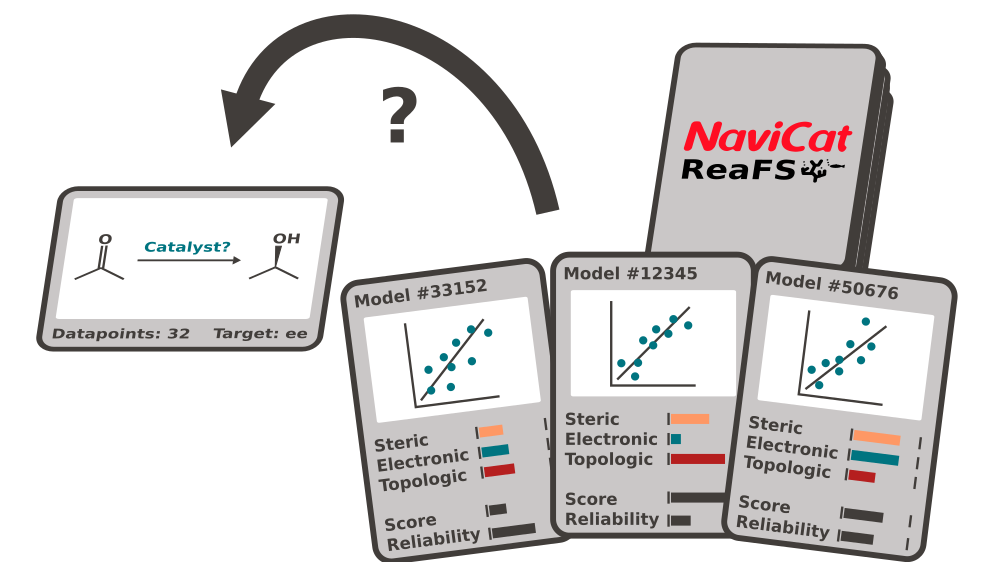
To overcome these limitations, we introduce ReaFS (Reaction Feature Selection), a comprehensive framework of data, feature, and model diagnostics designed to identify statistically robust MLR models for any given reaction. ReaFS facilitates model selection by computing relevant metrics and enables an a priori assessment of model quality. Combined with Bayesian optimization and the interpretability of MLR, this approach enables more efficient and streamlined reaction optimization.